
12.09.2026
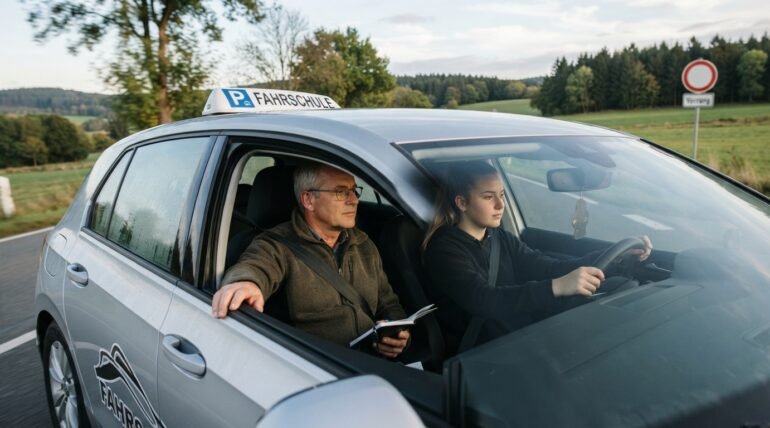
BF17 (Begleitetes Fahren ab 17) is a programme in Germany that allows young people to start driving independently at just 17 — on one mandatory condition: a pre-approved adult accompanying driver must always be present in the car. This system was introduced specifically to give new drivers more real-world practice in a supported setting before they end up on the road entirely on their own.
In this article, we take a detailed look at how the BF17 programme is structured, what requirements accompanying drivers must meet, how the necessary documents are issued, and why this system is considered one of the most effective ways to reduce risk for new drivers.
What the BF17 Programme Actually Is
BF17 is not a shortened or simplified version of a regular Class B driving licence — it’s an additional format built into the standard licensing procedure. The young learner goes through exactly the same driving school training and takes exactly the same theory and practical exam as adult candidates; the only difference lies in the conditions under which the licence can be used before turning 18.
From the moment the exam is passed successfully until the driver turns 18, they may only get behind the wheel in the presence of one of the pre-approved accompanying drivers. Fully independent trips — with no accompanying driver in the car — are not permitted during this period and are legally treated as driving without a valid licence for that specific situation.
What Age Can You Start Training At
In theory, a future candidate can start driving school — both theory lessons and the first practical hours — several months before turning 17, so they’re fully prepared to take the exam right when they reach the required age. This approach allows the workload to be spread out sensibly, rather than trying to cram the entire training course into a short period right after the birthday.
The practical exam itself is typically scheduled as close as possible to the candidate’s 17th birthday, since obtaining a driving licence — even in the BF17 format — is not legally possible before this age.
Who Can Be an Accompanying Driver
Several formal requirements apply to accompanying drivers, designed to ensure that a genuinely experienced and reliable person is at the new driver’s side. As a rule, the accompanying driver must be at least a certain age — most often 30 or older — must have held a valid Class B licence for at least five years continuously, and must not have a significant number of points on record in Germany’s Flensburg penalty points system.
Importantly, several accompanying drivers can be registered at once — these can be parents, other close relatives, or simply trusted adults who meet the requirements. This gives the young driver the chance to practise at different times and with different people, rather than depending on a single person’s schedule.
Key requirements for an accompanying driver, summarised:
- age — generally at least 30 years old;
- driving experience — a valid Class B licence held for at least 5 years;
- clean record — no significant number of points in the Flensburg register;
- number — several accompanying drivers can be registered at once.
How Accompanying Drivers Are Registered in the Documents
Details of each registered accompanying driver are recorded on a special official certificate for accompanied driving, issued together with the BF17 approval document. The young driver is required to carry this certificate at all times during any trip, along with the driving licence itself, and to present it if requested by police.
If there’s a need to add a new accompanying driver after the licence has already been issued — for example, another family member becomes eligible and willing to accompany — the relevant changes must be registered with the competent authority before that person actually starts accompanying trips.
Every BF17 trip requires the driver to carry:
- the driving licence;
- the accompanied driving certificate (Prüfungsbescheinigung), listing all registered accompanying drivers.
Can You Drive Abroad Under BF17
Yes — many European countries recognise the accompanied driving programme under international agreements, and trips with an accompanying driver are possible outside Germany as well. That said, since the list of recognising countries can change over time and the recognition conditions sometimes differ in detail, it’s worth checking the current information before planning a trip abroad — for example, on the relevant authority’s website or directly with the driving school.
What Happens at Age 18
Once the driver turns 18, BF17 status ends automatically, with no additional formalities, and the driver gains the full right to drive independently, without an accompanying driver present. No new exam, extra visit to any authority, or document reissue is required — legally, the restriction simply stops applying on the birthday itself.
What’s the Practical Benefit of the Programme
The biggest and most obvious advantage of BF17 is extra months of real driving practice under the widest possible range of conditions: in the city and on rural roads, in daylight and darkness, in good weather as well as rain or snow — always with a more experienced driver alongside who can offer timely advice or, if necessary, intervene in a critical situation.
Official statistics in Germany have shown a consistent trend for many years: young drivers who go through the accompanied driving programme are statistically less likely to be involved in road accidents in the first months of fully independent driving compared to those who hit the road without an accompanying driver right at 18. This exact gap in accident rates was the original reason the programme was introduced at the state level.
Key benefits of BF17, summarised:
- extra months of real driving practice in varied conditions — city, rural roads, day and night, different weather;
- support from an experienced driver throughout the entire learning period;
- statistically lower accident rates in the first months of fully independent driving;
- a gradual rather than abrupt transition to full independence behind the wheel.
Are There Time or Route Restrictions During BF17
The programme places no formal restrictions on specific routes or times of day — a young driver with an accompanying driver in the car can drive exactly like a regular adult driver, including night trips, longer journeys, and driving on the motorway. The one genuinely strict condition of the programme is the continuous physical presence of the registered accompanying driver in the vehicle for the entire trip, with no exceptions.
Should You Choose BF17 or Wait Until 18
If a family can find a suitable accompanying driver among relatives or trusted adults and is willing to take on some extra organisational effort — coordinating schedules, driving together — the BF17 programme offers a clear, statistically well-documented advantage. By the time they reach full independence at the wheel at 18, such a driver has already accumulated up to a year of practical driving experience across a wide range of conditions — and this initial period is statistically the most dangerous for any new driver, regardless of which path they took to get their licence.
BF17 isn’t a shortcut or a simplified route to a driving licence — it’s a well-designed system that offers young drivers a genuine opportunity to build real practical experience in a supported, lower-risk setting before they end up on the road entirely alone. For many families, it represents a sensible, statistically well-founded compromise between giving a teenager early mobility and ensuring a cautious, gradual transition to fully independent driving.