
29.08.2026
The practical driving test is the final — and for most learners, the most nerve-wracking — step on the way to a driver’s licence. By this point, dozens of hours of theory and practical lessons already lie behind the candidate, but it’s the last 30 to 40 minutes behind the wheel that decide whether the long-awaited licence is issued. Unlike the theory test, there’s no list of correct answers to memorise here — what matters is proving that driving has become a stable, automatic skill rather than a set of rehearsed actions that fall apart under the slightest stress.
In this article, we break down exactly how the practical driving test is organised in Germany, which criteria the examiner (Prüfer) focuses on first, which mistakes statistically cause the most failures, and what genuinely helps candidates pass on their first attempt.
How the Test Works
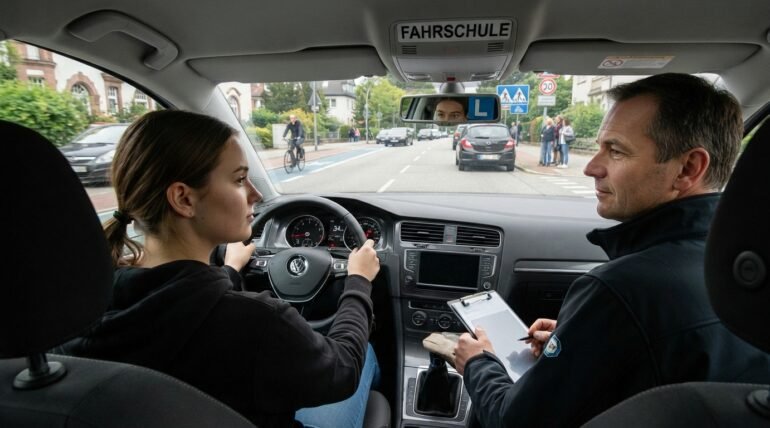
The practical driving test in Germany typically lasts around 45 minutes, of which the candidate spends roughly 25 to 30 minutes actually driving — the rest of the time goes to getting seated, briefing, and recording the result. Besides the candidate, the car carries the examiner and the driving instructor from the school: the instructor does not intervene or give hints during the test, but agrees on the final result together with the examiner afterwards.
The route is not known to the candidate in advance and is designed to cover a range of traffic situations: busy city streets with intersections and pedestrian crossings, a rural road or a stretch of motorway where possible, and one or more special manoeuvres such as parallel parking, a turnaround in a tight space, or reversing with proper mirror use.
An important detail that is often underestimated: part of the route is driven not on the examiner’s direct instructions but independently, guided by road signs, direction indicators, or simple instructions like “follow the main road.” This element of the test checks not the mechanical following of commands, but the candidate’s real ability to make decisions independently while driving in traffic — which is, ultimately, the whole point of the training.
Key Grading Criteria
It’s important to understand that the examiner doesn’t grade individual manoeuvres in isolation, but the overall ability to drive safely, predictably, and confidently in real traffic conditions. The final decision is made up of several interconnected areas.
Compliance with traffic rules. This is the foundation the rest of the evaluation is built on. Speed limits, right of way at intersections, timely use of turn signals, safe following distance — violations of these basic requirements are judged most strictly, since they directly relate to accident risk.
Observation of the traffic situation. The examiner closely watches whether the candidate checks mirrors before a manoeuvre, whether they turn their head to check blind spots, and how they react to pedestrians, cyclists, and other road users. What’s graded here isn’t the formal performance of an action but whether the candidate genuinely “reads” the road situation in advance rather than reacting after the fact.
Smoothness and confidence behind the wheel. Sudden braking, jerky starts, hesitant or delayed gear changes — all of these signal to the examiner that the basic motor skills aren’t sufficiently automated yet, and the candidate lacks experience even in low-stress conditions, let alone more demanding ones.
Decision-making in ambiguous situations. Special attention is paid to navigating unmarked intersections, situations with unclear right of way, and reactions to unusual or unexpected manoeuvres by other drivers — such as a sudden lane change by a neighbouring vehicle.
Execution of special manoeuvres. A separate block evaluates the precision and safety of assigned manoeuvres: parallel parking between two cars, turning around in a limited space, driving in reverse straight or with a change of direction. What matters here isn’t just the end result — the car ending up in the right spot — but how the candidate controlled the surrounding space throughout the entire manoeuvre.
In summary, the examiner’s final grade is built from five key areas:
- compliance with traffic rules — speed, right of way, turn signals, following distance;
- observation of the traffic situation — mirror checks, blind spot control, reaction to pedestrians and cyclists;
- smooth driving — confident, predictable actions without jerks or hesitation;
- decision-making in complex situations — unmarked intersections, unclear priority, unexpected manoeuvres by others;
- execution of special manoeuvres — parking, turning around, reversing.
Common Mistakes That Lead to Failure
Statistics from German driving schools and the experience of instructors show that the vast majority of failed attempts are not caused by rare or unusual situations, but by a recurring set of the same mistakes.
Insufficient blind spot checks. This is one of the most common reasons for failing the test. Changing lanes or starting to move without a full mirror check and a head turn to check the blind spot is treated by the examiner as a direct safety risk — even if no car actually happened to be there at that particular moment.
Failure to yield right of way. Misjudging the situation at an unmarked intersection, an error when pulling out from a minor road onto a main one, inattention to priority signs — critical mistakes, since they directly mirror real-world causes of road accidents.
Excessive hesitation or overcaution. Paradoxically, driving too slowly and indecisively is also treated as a problem. Long hesitation before pulling out at a completely clear intersection, or panicked fear of overtaking where it’s objectively safe, signals to the examiner a lack of confidence in one’s own skills — which can itself create risk for other road users forced to adapt to unpredictable behaviour.
Errors during parking and manoeuvres. Clipping the kerb, going outside the marked lines during parallel parking, multiple attempts to correct the car’s position — such mistakes rarely cause failure on their own, but combined with other shortcomings, they significantly affect the overall grade.
Failure to maintain the correct speed. This includes both exceeding the speed limit and driving noticeably slower than permitted without objective reason — both are considered a failure to adapt properly to the flow of traffic.
The five mistakes that most often cause candidates to fail:
- insufficient blind spot checks when changing lanes or starting to move;
- failure to yield right of way at unmarked intersections;
- excessive hesitation or overcaution behind the wheel;
- errors during parking and other manoeuvres — kerb, markings, repeated corrections;
- failure to maintain the correct speed — both speeding and driving unnecessarily slowly.
How to Improve Your Chances of Passing on the First Try
Preparing for the practical driving test is less about memorising individual manoeuvres and more about building a stable, automated habit of acting correctly in any conditions. A few practical recommendations from instructors:
- Practise routes under different conditions — not just familiar roads near the driving school, but also unfamiliar areas where you need to orient yourself quickly based on the actual situation rather than memory.
- Pay special attention to blind spot checks — turn this into a fully automatic habit so it happens on its own rather than requiring conscious effort in a stressful moment.
- Practise special manoeuvres until they no longer require lengthy thought — parallel parking and turning around in tight spaces should become routine actions.
- Discuss specific weak points with your instructor before booking the test — honest, specific feedback at this stage saves far more time, money, and nerves than a formal “you’re ready.”
- On test day, try to keep your natural, familiar driving pace — trying to make everything “perfect” often backfires, leading to tension, delayed reactions, and mistakes that never happened during regular lessons.
The practical driving test in Germany doesn’t test memorised routines — it tests genuine readiness to drive safely in varied, often unpredictable conditions. Understanding what the examiner actually looks for — observation of traffic, rule compliance, smooth driving, and an appropriate response to the situation — makes it possible to approach the test with awareness and noticeably less stress on the decisive day. Systematic preparation throughout the entire training course, rather than last-minute cramming, gives candidates the best chance of passing on their first attempt.