08.08.2026
Category B, which most drivers hold, only allows towing light trailers, with a limit on the combined permissible weight. As soon as a heavier trailer, a caravan, or a boat comes into play, category BE becomes essential. Here’s who needs it and how the training works.
How category BE differs from the basic category B
Category B allows towing a trailer if the combined permissible maximum weight of the car and trailer does not exceed 3,500 kg, or if the trailer is light (up to 750 kg) regardless of the towing vehicle’s weight. Once this limit is exceeded, the separate category BE is required, removing this restriction and allowing heavier trailers to be towed up to the technical limits of the coupling.
Who needs category BE the most
- Owners of motorhomes and large caravans — the weight of a living trailer often exceeds the basic category B limits
- Anyone transporting boats, snowmobiles, or other large equipment on a trailer
- People planning a move with a large cargo trailer without hiring a moving company
- Small business owners who need to tow a trailer with equipment or goods
- Outdoor enthusiasts regularly transporting trailers with ATVs, bicycles, or other sports equipment
What category BE training includes
- Trailer towing basics — understanding how a trailer affects handling, braking, and manoeuvrability
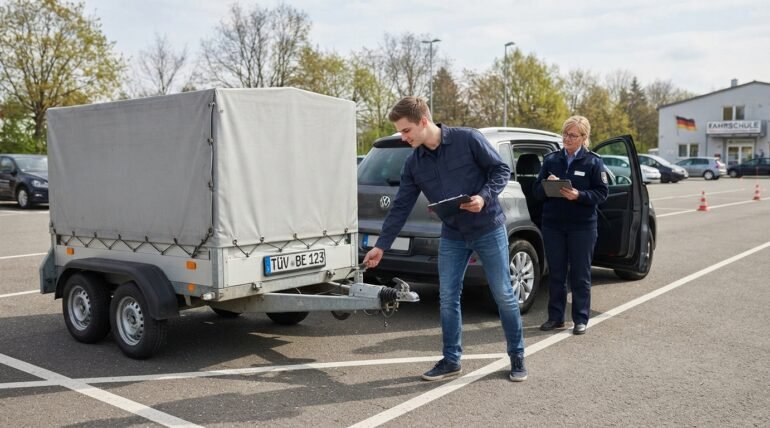
- Manoeuvre practice — reversing, turning, and driving on winding roads with a trailer require a completely different technique compared to a single vehicle
- Coupling and uncoupling the trailer — the correct sequence of actions, checking couplings and electrical connections
- Load distribution — understanding how improper trailer loading affects the stability of the combination on the road
- Practical driving in real conditions — in the city, on highways, and on a manoeuvring course
Is there a separate exam for category BE
Yes, the exam is taken separately from category B and includes both a theory part (if required) and a mandatory practical part with a trailer. The examiner assesses not only basic driving skills but also specific manoeuvres — above all, reverse parking with a trailer, considered one of the most difficult elements for beginners.
How long the training takes
The duration depends on the driver’s existing skill level and how quickly they master the specifics of driving with a trailer. Since category BE is an addition to an already existing category B, training usually takes less time than getting a licence from scratch, but requires solid practice of manoeuvring skills specifically.
Common difficulties for beginners
- Underestimating braking distance. A loaded trailer significantly increases the distance needed to come to a complete stop.
- Mistakes when turning and parking. The steering logic when reversing with a trailer is the opposite of what feels intuitive — this takes practice.
- Neglecting the side mirrors. Driving a combination requires more active monitoring of the space alongside the vehicle.
Category BE opens up possibilities not available with a basic category B licence — from motorhome travel to transporting large equipment. Well-structured training with a focus on manoeuvres makes passing the exam significantly easier and turns towing a trailer into a safe habit rather than a source of stress. At in7days driving school, we prepare students for category BE with an emphasis on practical training of complex manoeuvres.