17.11.2026
The language barrier scares many people who want a German driving licence: Russian speakers, Ukrainians, Poles, Romanians, Moldovans and anyone new to the country. It can seem that without fluent German the road to a licence is closed. It is not. Lessons, theory preparation and even the theory test are possible in several languages. But the system has important features worth knowing in advance.
This article walks through the whole route in stages, from your first visit to the driving school to the practical test, and shows where your own language helps and where you will need German.
What works in your language and what doesn’t
| Stage | Language |
| Training at the driving school (theory, driving lessons) | Possible in several languages, depending on the school |
| Theory preparation (textbooks, apps) | Available in many languages |
| Theory test | Can be taken in a number of languages |
| Practical test | German only |
According to Fahrschule Hohenbaden, driving instruction is available in seven languages (German, English, Romanian, Polish, Russian, Ukrainian and Moldovan), and the theory test can be taken in 13 languages. The practical test is conducted only in German. Please check the current list of languages with the school.
Stage 1. Choosing a school and the first conversation
Start with a driving school where explanations in your language are possible. This is not just about comfort: traffic rules and the German system are understood better when you know exactly what is being said.
What to ask when signing up:
- in which languages theory and practice are taught;
- in which languages materials and learning apps are available;
- which documents are needed for registration;
- how the schedule works (for example intensive courses);
- which branches exist and their opening hours.
Fahrschule Hohenbaden operates in Baden-Baden and Bühl, so you can choose the branch closer to your home or work.
Stage 2. Documents and preparatory steps
For registration and the licence application you usually need:
- proof of identity and proof of residence;
- a biometric photo;
- an eyesight test certificate (Sehtest);
- a first-aid course certificate.
The exact list depends on your situation and on the authority that accepts the application (Führerscheinstelle). The school will help you put the list together and explain the order of steps.
Stage 3. Theory in your own language
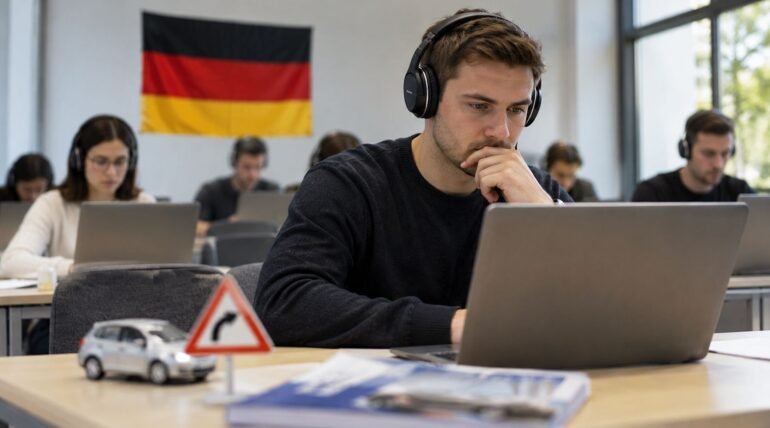
The theory course is the most comfortable stage for people whose German is not yet fluent. You learn traffic rules in a language you understand and go through signs, situations and test questions.
How to prepare effectively:
- attend lessons and ask questions: explanations in your own language remove half the difficulties;
- use apps and online trainers with translated questions;
- learn the German terms alongside: “Vorfahrt” (right of way), “Geschwindigkeit” (speed), “Abstand” (distance), “Überholen” (overtaking). You will need them in practice;
- take practice tests and analyse your mistakes instead of just memorising answers.
Important. The theory test can be taken in several languages, but questions are often built on wording where nuances are easily lost. Translation helps, but be sure to go over tricky formulations with your teacher.
Stage 4. Practice: driving lessons
Driving lessons are possible in several languages, which is a big advantage: your instructor can explain techniques and mistakes so that you understand them exactly. But because the exam is in German, you should gradually get used to German instructions.
What to do:
- learn with your instructor the key commands used in the exam: “rechts abbiegen” (turn right), “links abbiegen” (turn left), “geradeaus” (straight ahead), “anhalten” (stop), “einparken” (park), “Spur wechseln” (change lane);
- listen to them and repeat them in lessons until they become automatic;
- ask your instructor to run part of a lesson in exam format, with commands in German.
The same applies to the mandatory special drives (country roads, motorway, dusk): you can learn in a language you understand, but you should know the terminology in German.
Stage 5. The practical test in German
The practical test is conducted in German. The examiner gives instructions on the road, and you have to understand and carry them out. This does not mean flawless German is required: understanding a limited set of commands and phrases, and knowing basic words for communication, is enough.
How to prepare:
- learn the exam vocabulary: directions, actions, parking manoeuvres, names of car parts;
- ask your instructor to simulate exam situations;
- get to know the procedure in advance: how long the exam lasts, what is checked, how mistakes are assessed;
- if you did not understand an instruction, don’t guess. Calmly ask again; that is acceptable, and an unnecessary manoeuvre can cost more.
You can read more about how the exam works in our article “The Practical Driving Test in Germany”.
Common fears and answers
“I’ll fail because of the language.” Experience shows the language barrier doesn’t necessarily stand in the way of success. The exam language is limited and predictable, and you can learn it.
“Theory in my own language is harder.” Not necessarily. Many people actually understand the meaning of questions better in their own language, but it is worth practising in German too to get used to the terms.
“I’ll have to wait a long time.” Duration depends on the format. Driving schools usually have intensive courses and standard programmes: ask what suits your schedule.
“I already have a licence from another country.” In that case, conversion may be possible, but the conditions depend on the country and your situation. More in our article on licence conversion.
Checklist for the start
- Decide in which language you prefer to learn and choose the driving school.
- Collect your documents and book the eyesight test and first-aid course.
- Complete the theory and practise tests.
- Learn German terms alongside practice.
- Practise the exam commands.
- Take the practical test calmly and ask again if needed.
The language barrier is not an obstacle but a task you can solve. You can learn to drive and take the theory test in your own language, and for the practical test you only need a small set of German commands. If you choose a school that explains things in a language you understand and prepare systematically, the road to your licence will be calmer and shorter. Sign up at Fahrschule Hohenbaden in Baden-Baden or Bühl and discuss your route with an instructor. Please check current conditions, languages and prices directly with the school.